The Lithuania-Latvia Connection: Latgale
- kapochunas
- Jul 16, 2025
- 4 min read

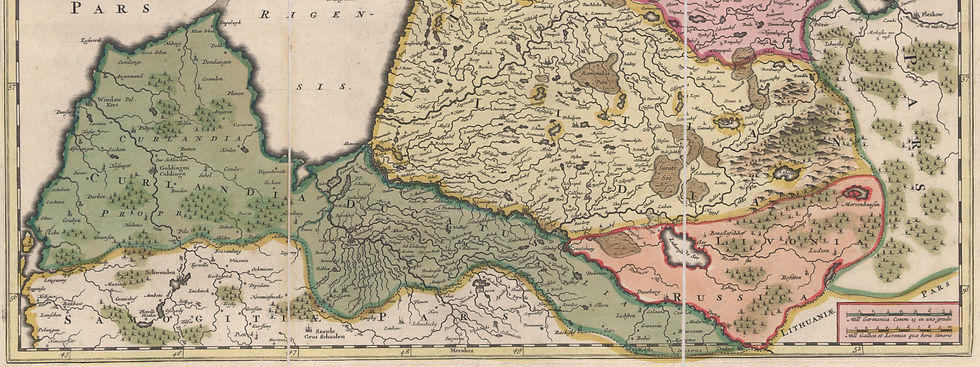

1680 Frederick de Wit (mapmaker/engraver/publisher): "Ducatuum Livoniӕ et Curlandiӕ, Nova Tabula..," Amsterdam, from Univ. of Tartu, Estonia: www.dspace.utlib.ee/ De Wit's labeling is in error: Latgale was briefly annexed by Russia 1577-82, and was not part of Russia again until 1772.
Four hundred and sixty-six years ago, in 1559, at the end of the Livonian War, the Grand Duchy of Lithuania annexed Latgale, naming it "Livonijos vaivadija." Ten years later, as a result of the creation of the Polish-Lithuanian Commonwealth, it was jointly administered by the Grand Duchy and the Kingdom of Poland (while briefly annexed by Russia 1577-82) until 1772, the First Partition of the Polish-Lithuanian Commonwealth.
Latgale's key city, and the second-largest in Latvia: (“Duneburg” on the detail map above) “Daugpilis” in Lithuanian, was “Dünaburg” in German, its “official” name from 1275- 1893 because Baltic Germans held sway in the region even within Russia. It was “Двинcк” "Dvinsk" in Russian from 1893-1920, and “Daugavpils” in Latvian, "Daugpiļs" in Latgalian, 1920 to this day.
As a result of hundreds of years of influence by Lithuania and Poland, the people in Latgale (255,968 as of 2020) differ from the rest of Latvia in history, religion, language and traditions. The territory of what is now Latgale was originally populated by the Eastern Baltic Latgalian tribe.

Latgale's history is different: it was influenced by Lithuanian, Polish and Russian rule, while the rest of today's Latvia was largely influenced by German and Swedish rule.
Latgale's religions differ from the rest of Latvia: it is (from a 2011 survey) 65.3% Catholic (see information about and photos of Aglona, below), and 23.8% Eastern Orthodox -- of which 13.8% are Russian Orthodox Christians and 10.0% Old Believers. In Latvia overall, according to 2019 estimates, 36% are Lutheran, 18.7% are Catholic, and 13.3% Eastern Orthodox. 30.6% did not ascribe to any religion.
Latgale's language, Latgalian, is linguistically close to Latvian -- comparable to how Samogitian and Lithuanian differ. There is much discussion these days as to whether it is a distinct language or a dialect of Latvian. The 2011 Latvian census established that 164,500 Latvians, 8.8% of the total population, speak Latgalian daily, 97,600 of them living in Latgale.
Latgale's traditions are different in its focus on ceramics, with Silajāņi ceramics the best-known subset:

One of the most important Catholic spiritual centers in Latvia is located in Aglona, population 1,000. Built in 1780, the Basilica of the Assumption is a Baroque church and monastery that is one of just eight international shrines recognized by the Vatican. Thousands of pilgrims from Latvia and abroad visit Aglona every year on August 15 to attend the feast day of the Assumption of the Blessed Virgin Mary. Aglona has been twice visited by a Roman pontiff: Pope John Paul II in 1993, Pope Francis in 2018.

The expansion of Aglona’s religious buildings is still under way. A new "Christ the King Hill" has been completed east of the church, merging Christian themes with 21st century folk and land art.

From mindtrip.ai
On my September 2015 trip with cousins, from Žiežmariai to Latvia, we didn't make it to Aglona -- the focus of the trip was the beer breweries around Panevėžys, Pakruojis, and Biržai, Rundāle Palace Museum (https://rundale.net/en/ ) near Bauska, Latvia, and the Mark Rothko Museum in Daugavpils, Latgale.

At the wikipedia entry for Daugavpils you will find eight listings for prominent cultural sites, most with hotlinks to websites, but no listing for the Rothko Museum -- only a small photo, despite the fact that Markus Yakovlevich Rothkowitz was born in Daugavpils (then called Dvinsk), and lived there from 1903-13, when he immigrated with his parents to New York City. Daugavpils is, quoting his museum's website (https://rothkomuseum.com/en/museum/): "...the only place in Eastern Europe where visitors can explore the work of Mark Rothko, the world-renowned Daugavpils-born American artist, master of abstract expressionism and color-field painting." His daughter Kate tells of his memories of being allowed to sleep on top of the family's brick stove, about ice-skating to school on the Dvina River, about frequent family picnics on the river banks, and trips by river boat to the left bank to visit fairs with a merry-go-round. Talking with his friend artist Robert Motherwell, Rothko recollected the glorious Russian sunsets over the river and spacious flat horizontal planes. It is from here, the museum's website says, that he borrowed this illusive northern light, dispersed like curling mist in his classical works.
The Rothko Museum collection dates back to 2003, the centenary of Mark Rothko, when the artist’s children donated 41 high-quality reproductions of Rothko's works -- printed on canvas in their original size -- to the city of Daugavpils. The museum regularly features his original paintings on loan from his children's private collection. Six original Rothko paintings are currently on view in Daugavpils. It is well worth a visit.




Comments